
Research Article
State of Sport Management Research in 2025: An Overview


State of Sport Management Research in 2025: An Overview
Vassil Girginov, Brunel University of LondonThe current issue of the Sport Management Digest (SMD) provides a bibliometric analysis of the research published in the 10-sport management journals during the year 2025. The four thematic sections that follow cover in sufficient detail research pertinent to different aspects of sport management. Owing to some editors stepping down and the time needed to replace them, we were unable to include a review of sport management theoretical developments, ethics research, leadership and marketing. These sections will be made available as soon as possible. Bibliometric analysis is the main tool used in science mapping, which allows to reveal the social, intellectual and organisational structure of sport management as a discipline. Bibliometrics is an established computer-assisted quantitative review methodology which identifies core research or authors, as well as their relationships. It provides valuable relational information on the topic, which helps significantly enhance our understanding of the overall state of the sport management discipline.
Following the established review format, the present overview of research in the field of sport management focuses on three interrelated areas, including a bibliometric analysis, the theoretical and practical appeal of research, as measured by the funding received by different studies, and the democratisation of knowledge, as exemplified by the number of studies published under the Open Access (OA) regime. In 2025, the ten sport management journals combined published 54 issues with 419 articles. This is a significant number of outputs, which exceeds the number of published articles in previous years. These outputs were produced by a diverse group of researchers, including established and upcoming scholars as well as PhD students. For example, the 37 articles in the Journal of Sport Management were produced by 88 authors, 158 authors were responsible for 54 articles in the Sport Management Review, and the European Sport Management Quarterly published 79 articles written by 150 scholars. These numbers are indicative of the collaboration between scholars in tackling the complex issues facing sport management. It is also worth noting the dominance of the USA-based scholars. Except for two journals, including the International Journal of Sport Finance and the International Journal of Sport Policy and Politics, where German and the UK-based authors were in the majority, publications in the rest of the journals were overwhelmingly dominated by scholars based in US institutions. This is understandable, given the large number of sport management programmes in the USA.
Table 1 shows the ten journals and the number of articles per journal, including those published OA. In 2025, out of the 419 articles across the ten journals, 144 were published OA, which represents 10% of the total output. The International Journal of Sport Policy and Politics (33 articles), Journal of Sport Economics (33 articles), and the European Sport Management Quarterly (31 articles) have been well ahead of the rest of the journals in this regard, with 62%, 92% and 39% of their content published OA, respectively. Xiaoyan Xing’s article in the previous SMD issue offers a detailed analysis of the geography of sport management publications.
Table 1. Total number of articles and Open Access ones published in the 10 sport management journals in 2025
| Journal | Founded | Publication frequency/ year |
Impact factor 2023 |
Articles No |
Open Access No/% |
|
Journal of Sport Management (JSM) https://journals.humankinetics.com/view/journals/jsm/jsm-overview.xml |
1987 | 5 | 3.7 | 37 | 4/16 |
|
Sport Management Review (SMR) https://www.tandfonline.com/loi/rsmr20 |
1998 | 5 | 4.1 | 54 | 7/13 |
|
International Journal of Sports Marketing and Sponsorship (IJSMS) https://www.emerald.com/insight/publication/issn/1464-6668 |
1999 | 4 | 3.4 | 53 | N/A |
|
European Sport Management Quarterly (ESMQ) https://www.tandfonline.com/loi/resm20 |
2001 | 5 | 3.9 | 79 | 31/39 |
|
International Journal of Sport Finance (IJSF) https://fitpublishing.com/journals/ijsf |
2006 | 4 | 1.1 | 19 | 10/52 |
|
International Journal of Sport Communications (IJSC)
https://journals.humankinetics.com/view/journals/ijsc/ijsc-overview.xml |
2008 | 4 | 1.8 | 42 | 4/9 |
|
International Journal of Sport Policy and Politics (IJSPP)
https://www.tandfonline.com/loi/risp20 |
2009 | 4 | 2.8 | 53 | 33/62 |
|
Journal of Sports Economics (JSE)
https://journals.sagepub.com/home/jse |
2011 | 6 | 2.1 | 36 | 33/92 |
|
Communication and Sport (C&S) https://journals.sagepub.com/home/com |
2013 | 6 | 2.8 | 27 | 4/15 |
|
Journal of Global Sport Management (JGSM) https://www.tandfonline.com/loi/rgsm20 |
2016 | 4 | 2.2 | 19 | 8/41 |
As discussed in previous issues, the OA publication policy reflects an important imperative for the democratisation of knowledge, which suggests that all publicly and privately funded research ought to be made freely available for users. The challenges of the OA policy have been addressed in earlier issues of the SMD, including its prohibitive cost for many researchers and institutions. Nonetheless, it is important to keep stressing this issue as it plays a critical role in shaping the knowledge in the field and its utilisation for teaching and research purposes. Readers can check out the OA policy of their targeted journal by using the ‘Journal checker tool’ https://journalcheckertool.org/. Advances in digital technology and publishing have made it possible for journals to change their publication policy, particularly those published by Taylor & Francis (5 of the journals in the table). Editors and authors have now been instructed that there is no longer a cap on article word count, which is typically between 8,000-10,000 words. This means that authors could use the greater word allowance to expand on different sections of their papers, including the use of more illustrations.
Journals’ special issues serve the important role of trailblazers because they submit for discussion topical issues likely to shape research and policy agendas in the field of sport management. The positive impact of journals’ special issues in sport management and sociology was analysed by Scelles (2021) and discussed in previous issues. Four out of the ten journals reviewed in the current issue of the SMD have published special issues addressing the economics of combat sports, the politics of sport communications, and the new technologies and artificial intelligence in sport business. Thirteen editors were responsible for soliciting, reviewing and editing these special issues. Individually and collectively, these special issues make a significant contribution to advancing our knowledge and the field of sport management in general.
Table 2 shows the journals, special issues and guest editors.
Table 2. Special issues published by selected sport management journals in 2025
| Journal | Special Issue Topic | Editors |
|
Journal of Sport Economics 2025, 26 (2) |
The Economics of Combat Sport | Robert Butler |
|
International Journal of Sport Communications
2025, 18 (3) |
Politics, Sport, and Communication: A Global Perspective | Alex C. Gang, Mahdi Latififard, and Michael Mirer, |
|
Journal of Sport Management
2025, 39 (2) |
Reflexivity in Sport Management |
Scott Tainsky
Shannon Kerwin, Jon Welty Peachey |
|
International Journal of Sport Marketing and Sponsorship
2025, 26 (2) |
Promises, Paradoxes, and Perils: The Current State and Future Directions of Web3 Technologies and Brand Innovation in Sports Business | Yiran Su; Bo Li; Olan K.M. Scott; Jerred Junqi Wang |
|
International Journal of Sport Marketing and Sponsorship
2025, 26 (4) |
Artificial Intelligence and Sport Business |
Jerred Junqi Wang; Lunhua L. Mao; Brandon Mastromartino |
A new and growing trend has emerged in the publications across the ten journals concerning the relationship between sustainability and sport management. Previously, sport management education has been criticised as being built around the twentieth-century supposition that sport managers' main responsibility is private accumulation and revenue generation, and for failing to address issues related to social justice, sustainability, and community empowerment (Chen, 2022; Ličen & Jedlicka, 2022). Existing sport management education perpetuates the growth model of sport and is thus part of the sustainability problem (Gammelsæter & Loland, 2022; Hautbois & Desbordes, 2023). Without exception, all journals published articles addressing some of the United Nations Sustainable Development Goals (SDG) as follows: JSM (19), SMR (31), ESMQ (21), IJSF (1), IJSC (26), IJSPP (38), JGSM (6), C&S (61) and JSE (9).
Table 3 shows the four dimensions of sustainability and the relevant SDGs
Table 3. Dimensions and Sustainable Development Goals
| Ontology | Sustainable Development Goals |
| Human | 3. Good Health and Well-Being; 5. Gender Equality; 17. Partnerships for the Goals. |
| Society | 1. No Poverty; 2. Zero Hunger; 4. Quality Education; 16. Peace, Justice, and Strong Institutions. |
| Economics | 8. Decent Work and Economic Growth; 9. Industry, Innovation, and Infrastructure; 10. Reduced Inequalities; 11. Sustainable Cities and Communities; 12. Responsible Consumption and Production. |
| Environment | 6. Clean Water and Sanitation; 7. Affordable and Clean Energy; 13. Climate Action; 14. Life below Water; 15. Life on Land. |
A measure of the conceptual and practical relevance of sport management research to policy makers, practitioners and various public and private bodies is the funding provided to different research projects, which underpin the empirical studies published in the SMD. Naturally, the funding picture of current research is by no means complete due to a lack of information about the external funding behind the research, but it does allow us to note the geography and institutional support of sport management scholarly activities. The research published in 2025 was supported by several public and private agencies, including the EU Horizon 2000 call, the Innovation Fund Denmark, Australian Research Council, Social Science and Humanities Research Council of Canada, Arts and Humanities Research Council UK, German Institute of Sport Sciences, the Academy of Finland and others. A proxy measure of the relationship between external funding of sport management research and its theoretical and practical appeal is the increased impact factor of most sport management journals in the sample, including citation as a powerful measure of establishing the impact of journals on the research field (see Lis, 2020 analysis). However, as Scelles and Downward (2025) argued, the current ranking of sport management journals, including their impact factor, does not adequately reflect the quality and advances in the field, as no sport management experts sit on the Academic Journal Guide Scientific Committee.
The bibliometric analysis was conducted using the Scopus database, which provides access to all ten journals included in the SMD. As with previous issues, science mapping and visualisation were achieved with the help of the VOSviewer software (van Eck & Waltman, 2020). The aim was to examine the strength of the links between sport management research by looking into the co-authorship links (i.e., the number of publications two researchers have co-authored), co-occurrence links (i.e., the number of publications in which two terms occur together), and the bibliographic coupling links (i.e., the number of cited references two publications have in common). The strength of the link is represented by a positive numerical value, where the higher the value, the stronger the link. The results are visualised in Figure 1 and capture the co-authorship and co-occurrence links of all articles published in 2025.
Figure 1 below depicts the co-authorship links where two or more authors have worked together on a publication. Out of 785 authors who published in the ten journals, 39 met the threshold of working together on three documents, and the different colours in Figure 1 help see those collaborations. As can be seen, there have been five clusters of authors who have collaborated on various projects and publications. However, it is worth noting that not all authors have actually collaborated, while the rest of the clusters do not appear to be connected. Breuer, Feiler and Lee have the strongest links of 7, 7 and 5, respectively.
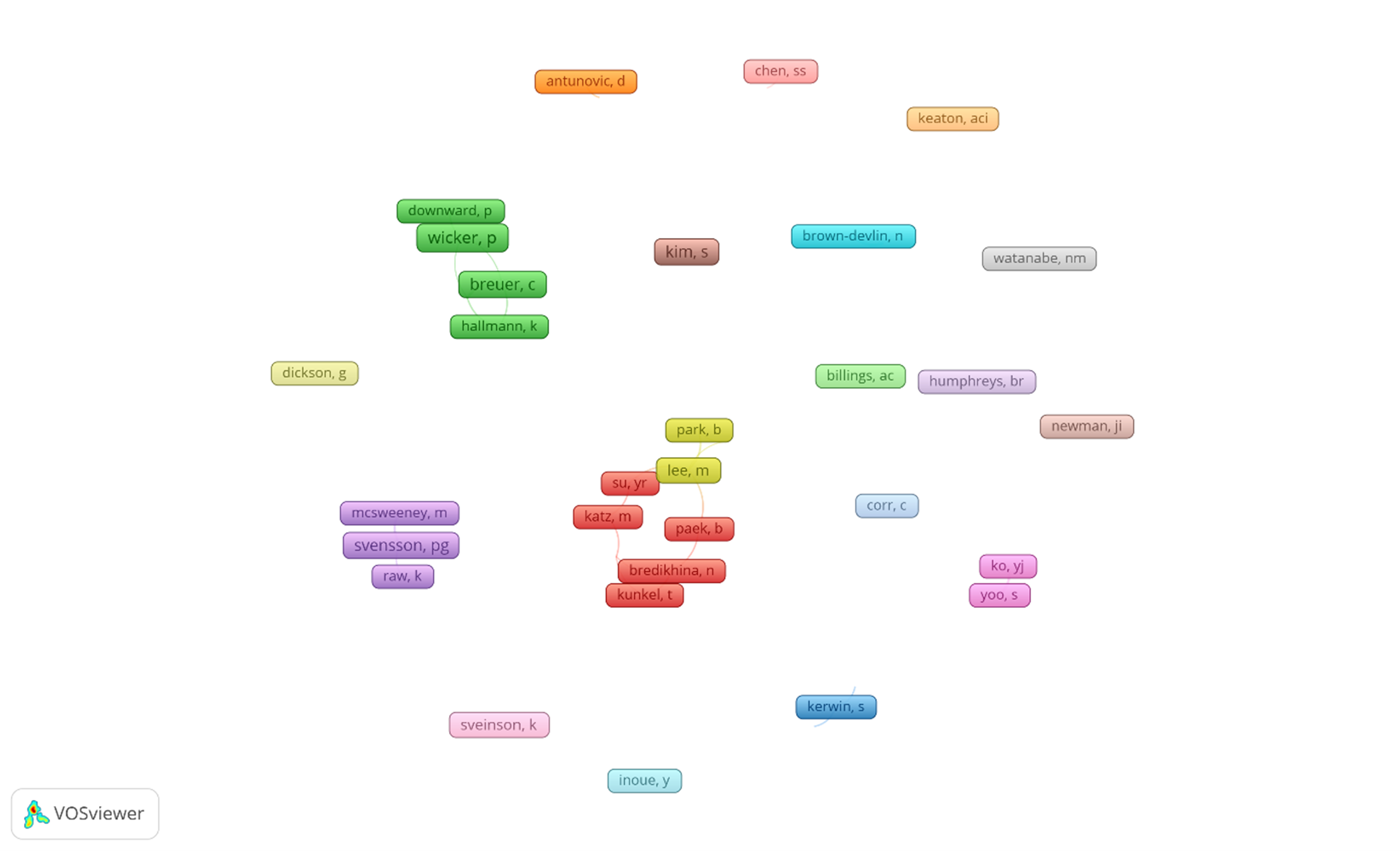
Figure 1. Co-authorship network visualization across ten sport management journals in 2025
The power of the different types of networks and the author co-citation (ACC) analysis lies in their ability to reveal the intellectual structure of the sport management discipline.
Naturally, the SMD does not claim to provide a comprehensive analysis of sport management research globally, as many studies are published outside the selected 10 journals included in this review. We do hope, however, that the Sport Management Digest offers a valuable guide to scholars, practitioners and students of sport. The high-level summaries included in this issue can serve as an entry point for understanding the intellectual structure of the discipline, the authors and centres responsible for producing the studies, as well as the topical issues discussed. It is hoped that it will help in stimulating debates and in informing decisions about research projects and teaching strategies.
Enjoy exploring the Sport Management Digest!
References
Chen, C. (2022). Naming the ghost of capitalism in sport management. European Sport Management Quarterly, 22(5), 663-684.
Gammelsæter, H., & Loland, S. (2023). Code Red for Elite Sport. A critique of sustainability in elite sport and a tentative reform programme. European Sport Management Quarterly, 23(1), 104-124.
Hautbois, C., & Desbordes, M. (2023). Sustainability in Sport: Sport, Part of the Problem… and of the Solution. Sustainability, 15(15), 11820.
Ličen, S. & Jedlicka, S. (2022). Sustainable development principles in U.S. sport management graduate programs, Sport, Education and Society, 27 (1), 99-112, DOI: 10.1080/13573322.2020.1816541.
Lis, A. (2020). Sport management: Bibliometric study of key sources titles in the research field. Journal of Physical Education and Sport, 20 (4), 2423-2430.
Scelles, N. (2021). "Impact of the special issues in sport management and sociology journals." Managing sport and leisure: 1-15.
Scelles, N. & Downward, P. (2025). Revisiting sport management journals in the Academic Journal Guide 2024: no improvement … this time? MANAGING SPORT AND LEISURE, https://doi.org/10.1080/23750472.2025.2482226
Van Eck, N. J., & Waltman, L. (2020). Software survey: VOSviewer, a computer program for bibliometric mapping. Scientometrics, 84(2), 523-538. https://doi.org/10.1007/s11192-009-0146-3